Biography
Western culture, media, and knowledge have dominated most of my life. As young as two, my media consumption consisted of Cartoon Network, Disney, and Nickelodeon, all of which are of American origin. Due to this, I have acted more western than Qatari; I adopted a western accent and subscribed to many western ideologies. Western culture was such a large part of my life that I had a hard time relating to other Qataris and related more to western individuals or other western influenced individuals. The lack of connection to my roots resulted in an identity crisis throughout my teenage years. Am I genuinely Qatari if I were better connected to the West than my own culture? What would my ancestors think if they saw me now?
I used to think that the best way to reconnect with who I am is to learn how I came to be and connect more with the culture. So, I took classes that helped me comprehend Arab history, politics, literature, art, and culture. However, the classes I took, the knowledge I have curated, and the people I have met made me think differently. There was no such thing as the perfect Qatari. I am no more nor less an Arab or Qatari at the beginning of this journey than at the end, but I have learned so much and am a greater person for it. We are all different in our own way and are all influenced by other aspects of life; however, that does not make us lesser.
The knowledge I acquired has given me greater confidence in myself and a greater understanding of my people in all aspects. This will be an excellent help and confidence boost for my future pursuits in international law.
My Question
A question remains today despite learning so much and feeling more connected to my culture and history. Will we, as Arabs, continue to segregate and differentiate from each other, or will we form a sense of unity as globalization persists?
Projects + Memos
2020
CULTURE
By: Noora Al-Thani, Noura Al Thani and Shaikha Al Thani
Context:
You might be able to tell that this video is one of my first major projects at this university. My first reaction was wanting to understand more about my own people, as at this point, what I desired most deeply was to connect, relate to and understand my culture. I do not remember meeting most of my grandparents as they passed away when I was younger, and my connection to my living grandma was never deep. Filming this video was my attempt to understand the older generation in a way that was impossible for me previously. At the time, this was my Middle-east studies. The history of my people.
However, when filming and conversing with the ladies of the Qudurat center, I realized that most of our culture is similar to the cultures of our neighboring countries. At that moment, I remembered meeting an old lady wearing a batoola and weaving baskets in Oman. I remember her talking to me about her way of life, beliefs, and hobbies, and I remember thinking that it was not so different from conversations I had had in Qatar. Although I entered this project believing that I was discovering Qatari culture more, I left it feeling as though I understood the greater Gulf more.
Work distribution:
Filming was equally distributed between Shaikha Al Thani, Noura Al-Thani, and I. Editing was equally distributed between Shaikha Al Thani and me.
2022
MEDIA
BY Noora Al-Thani and Shaikha Al Thani
Context:
I entered the course Arab television as an outsider having little knowledge of Arabic movies and television. The only show I watched and have a deeper connection to is Freej; therefore, freej was my first choice when asked to analyze an Arabic show. Researching this was both fun and educational. It was fun because I got to watch a show for research. It was educational because I started understanding more about modern Arabic television and its history. This was very important to me; how could I be an Arab if I didn’t know much about our entertainment? Ultimately, I did not care much for other Arabic shows and still stuck to my English ones once realizing that changing my consumption habits would only dissatisfy me and that there was no shame in enjoying western content more. However, I was still happy to have learned more about the topic.
Work distribution:
Work was distributed evenly.
2022
Music and arts
By: Noora Al-Thani and Tianyi Gang
Context:
I was on a roll. Most of my projects at this point were related to Arabic-speaking countries. I must admit, however, that when I proposed this idea to my teammate, it came from a place of frustration. Again, I arrived with a Qatari perspective, as my frustrations were aimed at Qatari culture and its strictness. However, as I researched and interviewed more people, I realized I once again boxed culture in. The more people I talked to, the more different perspectives I got. One of our interview subjects, Al-Khulaifi, described mixing western sounds with Arabian sounds, forming a hybrid sound. He wanted to input a part of his culture into his western derived interest. Through his description, I developed an idea for the ending and final argument of the article: the hybridization of our personalities. I then thought of people like me (as throughout my experience in NUQ, I have realized that many people are like me) as Hybrid Arabs. I also realized that maybe this wasn’t a problem. It doesn’t matter if I am Arab enough since I don’t even think there is a concept of “Arab enough.” Aren’t we all a mix of different personalities anyway?
Work distribution:
Writing and interviews are distributed evenly. Images and animation provided by me.
2022
Politics
By: Noora Al-Thani
Context:
Politics was always a primary interest of mine; however, I needed to learn more about politics in the Arab world, especially the politics of the 20th century. I learned so many things in this class I struggle to remember them all. I suddenly felt confident in both my historical and contemporary understanding of politics in the region. During this class, however, I no longer viewed my knowledge of the Arabian countries as how much I fit in but became interested in knowing more.
For example, I learned about the different politics in different Arab countries. For instance, concerning the Gulf, I was always told there was no room for democracy and that democracy would only bring ruin as it had in other Arab countries. For many, democracy simply did not fit in with Gulf countries’ culture. This paper was formed to disagree with this point and offer a perspective of the Gulf that opposes how it is presented to us.
2022
Sociology- syria
By: Noora Al-Thani
Context:
I grew up with constant news coverage of Syria in my house; however never fully understood what had happened. These papers allowed me to learn more and analyze the situation academically. The first paper was influenced by an interest in knowing more about a problem I had never heard of before. I lacked knowledge of the Kurdish people and decided to update my knowledge by discovering an aspect I had never heard of or known of before: the Kurds in Syria. The second paper was more personal. I had always believed that Gulf countries needed to do more in the case of helping Syrian refugees. I grew up hearing the word “misakeen” repeatedly, and the idea that donating was doing our duty. As I got older, I realized that, as a country, we didn’t help much beyond donations and temporary aid. That’s not to say we should stop donating; we must continue, but our governments should also be responsible for hosting more refugees and offering more permanent solutions. Learning more about the topic made me want to do more about it. Hopefully, I will be of more use in the future.
2022
2022
Sociology- palestine
By Noora Al-Thani, Moza Al-Kamali and Alreem Al-Khalifa
Context:
I felt similarly towards Palestine as I had towards Syria. I always felt as if I lacked knowledge of the two subjects. Studying, researching, and analyzing them was a pleasure for me. For the first paper, I was influenced by the idea that to group the two tragic cases of colonization was to understand more systematically what had happened, how, and why. It brought me a greater insight into not only Palestine but other cases of colonialism. The second work is a project split between three students. The posters offer statistics on Palestinian children and mental health in a bid for people to understand the dire situation they are in. The presentation was an attempt to solidify the argument and propagate the seriousness of the topic through scientific facts. I created this presentation to form an argument that would be more challenging to dismiss as people are less likely to ignore science. Through doing so, I learned much on the topic and hoped, once more, that I could be of more help in the future.
Work Distribution:
The paper and the presentation were by me. The posters were equally distributed between Moza Al-Kamali and Alreem Al-Khalifa.
Other Activities
Creative media festival- Shadow Art
This was a project by Shaikha Al-Thani and me. It is an art piece that conveys a father’s love for his daughter as he braids her hair and hums her a comforting song. We wanted to represent a positive viewing of Arab culture, one that counteracts the view some have of toxic masculinity and Arab fathers.
The video below shows the exhibit; the audio was the same one used during the presentation.
Moderator
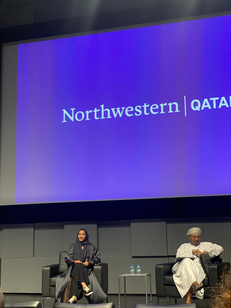
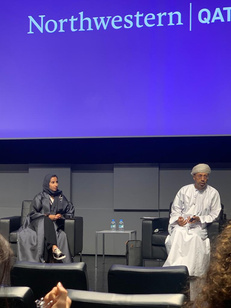
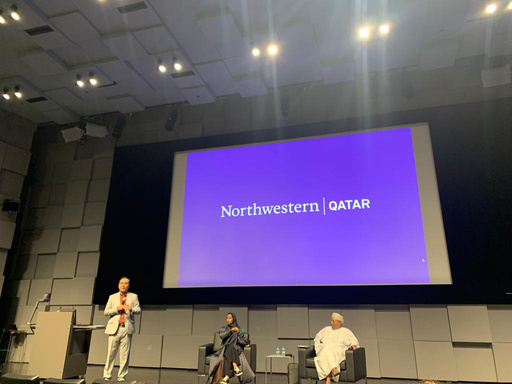
I volunteered to moderate a Middle East Studies minor talk by Abdullah Baabood. The experience was very educational, both in the case of the topic and learning how to speak on stage better. Baabood communicated the Middle East’s political, economic, and social aspects within the area of foreign policy expertly. He primarily focused on foreign policy and influence from East Asian countries and how these countries view the Middle East. Through moderating, I was fortunate enough to listen to Baabood’s talk closely and educate myself more on the Middle East and its foreign relations.
Qatar Culture Club volunteer
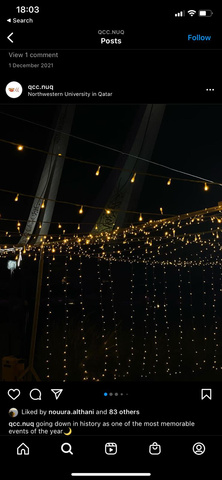
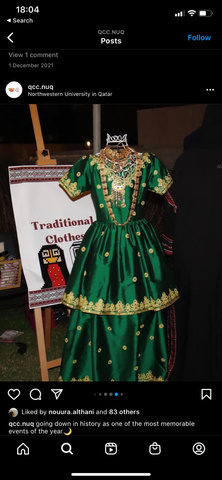
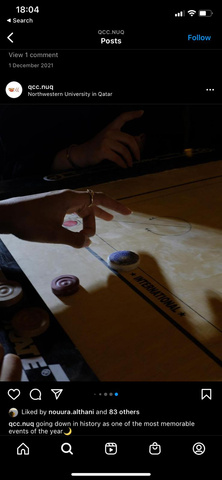
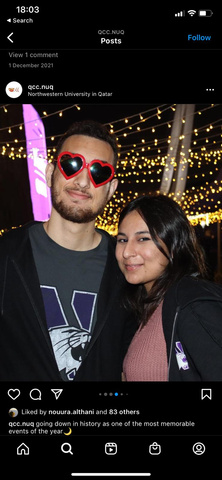
I volunteered for the Qatar culture club and helped them set up the location and man a booth. I would also regularly explain our items, their uses, and their history. (Pictures below derived from Club socials)
Connect with me
Noora Al-Thani
natalthaniqa@gmail.com
+974 7711 0444